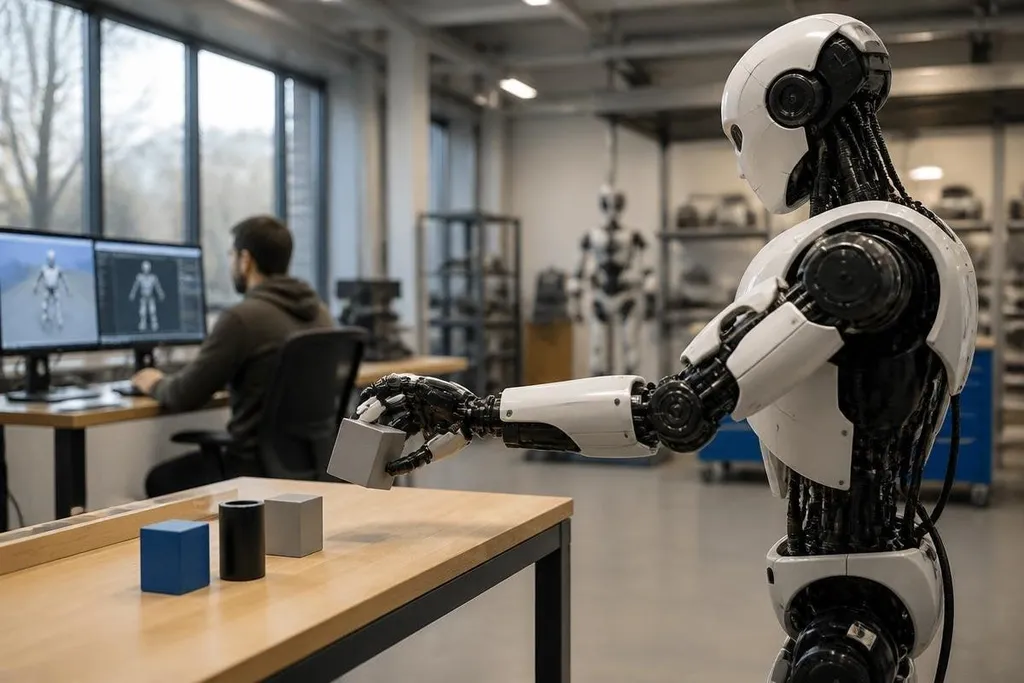
A robot can learn a new movement by studying examples, trying an action, or using both methods together. AI helps connect what the robot senses with the motor commands needed to move, so engineers don't have to write every step by hand.
- Examples guide motion: The robot copies movement data from a person, another robot, or a simulation.
- Practice finds errors: Trial runs show which actions fail, slip, or waste energy.
- Checks still matter: A learned movement needs limits before it reaches real equipment or people.
From examples to motor commands
Movement learning doesn't happen as one smooth idea. The robot receives data from cameras, force sensors, joint encoders, and other inputs, then links that data to actions such as turning a wrist or moving a leg.
This process is often called imitation learning. An operator moves the robot through a task, or a human wears sensors while performing it. The AI studies the recorded motion and builds a model that connects a situation with a likely action.
That model can then guide the robot when the same task changes slightly. A hand may approach a cup from a different angle, or an object may sit a few centimeters away from its usual place. The robot still needs enough training data to handle those changes safely.
The data has a direct effect on the result. If all examples show one table height, the robot may struggle at another height. If the gripper never meets a soft object during training, its force control may be poor when that object appears.
Trial and error in simulation
A second method lets the robot practice inside a computer simulation. The software models the robot's body, motors, sensors, and surroundings, then scores each attempt against a target movement.
This is useful for actions that would damage hardware during early practice.
During balance training, the robot can fall in simulation many times before engineers test the movement on the real machine. The simulation also lets a team run many practice attempts without waiting for a person to reset the robot after each failure.
The gap between simulation and real hardware still causes trouble. Real floors bend, motors heat up, cables drag, and sensors produce noise. Engineers add those effects to the simulation, then test the learned control on the robot with low speed and limited force.
Reinforcement learning uses a reward score to guide this process. The robot gets a better score when it reaches the target while using less force, less time, or less energy. A reward must be written with care. A robot told to reach a point as fast as possible may move too hard for a fragile object or nearby worker.
Dated Robot24.com robotics coverage can tie these learning methods to named robots and measured tasks. A movement that earns a high score in training can still fail on a real floor.
Why the movement can fail
AI does not remove the need for robot control software. It changes where some movement rules come from. Engineers still choose the sensors, set joint limits, define safe speeds, and decide when the robot must stop.
A learned movement can also fail when the scene changes beyond its training data. A different grip, a blocked path, a new surface, or a heavy object can alter the forces on the robot's joints. The system may need more examples or a separate recovery movement.
The hardest part is often judging success. Reaching the target once proves little. The robot needs repeated trials across the task's real range, with failures recorded rather than removed from the data.
I'd trust a learned movement only after the team shows its failure cases and the limits placed around it.
A practical check before deployment
Use this guide before allowing a learned movement near production equipment:
- Name the task: Write down the start state, target state, object, surface, and allowed contact.
- Review the data: Check that the training examples include the positions, loads, and sensor conditions the robot will meet.
- Test the edge cases: Try changes in object location, grip strength, lighting, floor position, and motor speed.
- Set hard limits: Cap speed, force, joint travel, and workspace before live trials begin.
- Keep a stop path: Make sure a person or safety system can stop the robot without relying on the learned model.
- Record failures: Save the sensor data and motor commands from bad trials so the next training round addresses the real problem.
The useful next step is a small live test with a clear pass rule, a slow speed, and a known failure response. If the robot can repeat the movement across the planned range without breaking those limits, AI has helped with the part that used to demand hand-written steps. If it cannot, more training data won't fix a missing safety rule.